Brown Chicken Stock

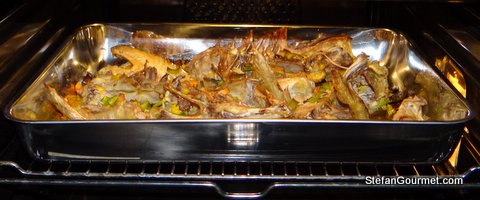
Good quality chicken is often sold as whole chickens. I take off the legs and breast, and use the rest to make stock. When making stock from bones, chefs differentiate between ‘white’ stock and ‘brown’ stock. The difference is that white stock is made from raw or blanched bones, whereas for brown stock the bones are roasted first. Brown stock has a more rich, fuller flavor than white stock. For the best Coq au Vin sauce, it is best to use a brown stock. Since I posted about Coq au Vin the other day, I thought I’d share a recipe for brown chicken stock with you. Please note that I did not include salt in the recipe because it is never a good idea to add salt to stock before you know what you are going to do with it. You may have to simmer the stock down to make a sauce, and then it may end up too salty. Continue reading “Brown Chicken Stock”

Coq au Vin

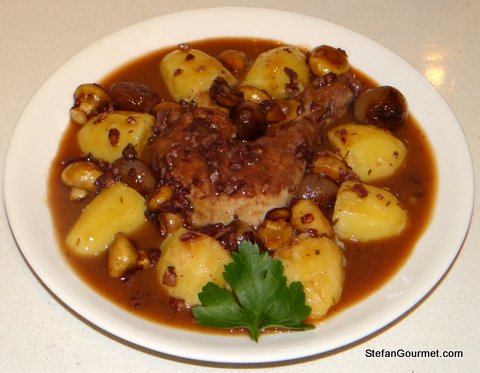
Coq au Vin is a prime example of classic French cooking. It is a lot of work, but worth it. “Coq” is French for rooster, and in times when people still ate roosters they were old and thus so tough that they needed to be stewed in wine to make them edible. Nowadays most chicken only gets to live about 6 weeks, so it is not needed to cook it like that anymore. But the flavor of the classic dish is so good that people keep making it anyway. Those old roosters had a lot of flavor, so this dish will benefit from using an older chicken like the one I discovered recently.

I have looked at various recipes online, most of them in French, and noted that they are all very similar. Chicken is browned, covered in red wine and stock, and then stewed until tender. It is served with sautéed mushrooms and braised pearl onions. Since Julia Child has been very important for introducing French cuisine to America, I thought it would be nice to follow her recipe from Mastering the Art of French Cooking. She made some adaptations to ingredients available in America, for instance she cooks the chicken only for a short time (because young chickens don’t need that long) and she blanches the bacon before using it (I think this is because bacon in America was — or still is? — too salty).

I believe the key success factors for a good Coq au Vin are: the quality of the wine, the quality of the chicken, the quality of the chicken stock, and cooking the onions and mushrooms separately and only adding them at the end. This will allow the mushrooms and onions to keep their own flavor. If you’ve never made braised onions before, I bet you’ll like them so much that you will make them again. Braised onions are very tender, flavorful, and sweet, and very different from raw or sautéed onions. Continue reading “Coq au Vin”
Cod in White Wine Sous-Vide

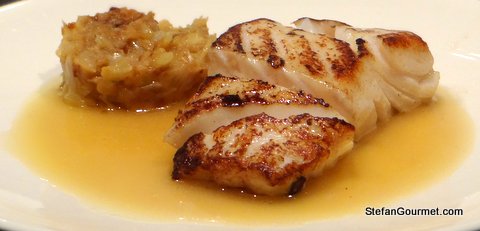
This is an improved version of the Sous-vide cod with braised fennel and white wine sauce that I made more than a year ago. Apart from what I’ve learned about plating and photography since then, the improvements in the recipe are:

  • the cod is cured before cooking sous-vide to improve flavor and texture;
  • the cod is now cooked in the sauce of white wine and shallots, which will impart a nice hint of the wine to the fish;
  • a different temperature for cooking the cod: 41C/106F instead of 54C/129F in an attempt to make it less flaky.

Continue reading “Cod in White Wine Sous-Vide”

Chicken Ramen From Scratch

Most people associate Chicken Ramen with instant noodles in a foam cup. You just need to add boiling water and it’s done. It doesn’t taste bad, but it is very different from the chicken ramen that I prepared today. I made everything from scratch, including the chicken broth and the noodles. Instead of cooking the chicken sous-vide like I did in my previous post about chicken ramen, I wanted to show you how you can approach the same result by cooking the chicken at a low temperature (between 65C and 70C or between 150F and 160F) and then taking the chicken meat off the bones and finish making the broth Making ramen noodles from scratch is just like making fresh Italian noodles, with the exception that baking soda is added to make the noodles alkaline (i.e. the opposite of acidic). This will give them a firmer texture when they are cooked in the broth.

I was very happy with the result. The broth had a very nice flavor, the chicken was tender and juicy, and the noodles had a nice texture. It takes a lot of time, but most if it is inactive so this is a great project for a rainy Sunday. Continue reading “Chicken Ramen From Scratch”

Sweet Potato Gnocchi (Gnocchi di Patate Dolci)

The preparation of sweet potato gnocchi is the same as regular potato gnocchi, and they have an interesting taste that is slightly sweet as the name implies. It is not difficult once you have made them a few times, and if you don’t add too much flour they can be nicely light and fluffy. To be able to taste the sweet potato I served them with a very simple sauce of butter and sage. If you like you can add a bit of sugar to make them even sweeter. Ingredients For 2 servings 400 grams (.9 lbs) sweet potatoes 100 grams … Continue reading Sweet Potato Gnocchi (Gnocchi di Patate Dolci)

Vanilla Sauce (Crème Anglaise)

The dessert I made for Conor and the wife was PutneyFarm’s chocolate-packed brownies, and to make it even more special I made some crème anglaise to turn it into something that looked like a plated dessert. Crème Anglaise is the French name for vanilla sauce, which should of course be made from scratch using a good-quality vanilla bean. Good vanilla beans are fragrant and sticky. Stay away from the dried out sorry excuses for vanilla beans that are often sold at supermarkets, although those are still better than using synthetic vanilla. Synthetic vanilla contains only the most prominent compound called vanillin, … Continue reading Vanilla Sauce (Crème Anglaise)

Hot-Smoked Scallops with Roasted Bell Peppers

When I mentioned hot-smoked scallops, Conor was intrigued. And so we decided to make this as an appetizer before the lobster and couscous, combined with roasted peppers because that is such a lovely combination. You could also add pea puree to that, but since we were already having peas with the couscous we left that out. Now I’ve blogged about hot-smoked scallops and about roasting peppers separately before, but Conor made such great pictures that I just had to share them with you. And I have not told you about the combination before, so there. Without further ado, here is how to … Continue reading Hot-Smoked Scallops with Roasted Bell Peppers

Bartolini-inspired Ravioli

The welcoming dinner for Conor and the wife was a full Italian cena consisting of four courses as explained here. We wished more of our blogging buddies could have joined us, but we tried to include them in spirit by cooking and eating their recipes. I used ChgoJohn’s recipe for a filling for cappelletti as inspiration for the ravioli for the primo piatto. The Bartolini family recipe for this stuffing includes pork, veal, spinach, cream cheese, pecorino, nutmeg, and lemon zest. I used ricotta instead of cream cheese and slightly different proportions, but I think it was pretty close to how ChgoJohn would … Continue reading Bartolini-inspired Ravioli

Venison and Bell Pepper Stew

Venison, bell pepper and paprika are a good combination that make for a very flavorful stew. If you can’t find venison, lamb is a good substitute. I served it with roasted parsnips and mashed potatoes. The recipe is very similar to the venison and bell pepper ragù I posted a few days ago. In fact, only the end of the preparation is different. Ingredients For 6 servings 900 grams (2 lbs) venison stewing meat, in cubes about 250 ml (1 cup) warm water or venison stock 3 red bell peppers 1 Tbsp hot paprika (or 2 tsp sweet paprika and 1 tsp … Continue reading Venison and Bell Pepper Stew

Roasted Parsnips

Roasting is one of my favorite ways to prepare vegetables because it concentrates the flavor and makes the outside nice and crispy. Getting the texture of roasted parsnips right can be tricky, so I use them most often to make puree. As PutneyFarm pointed out, roasted parsnips with excellent texture can be made by parcooking them first. Steaming is better than (par)boiling, because boiling will dilute the flavor rather than concentrating it. This is less of an issue with steaming, but I thought of a different solution if you have enough time. Since roasted parsnips are great as a side to a … Continue reading Roasted Parsnips

Spaghettini with Venison and Bell Pepper Ragù (Spaghettini al Cervo e Peperoni)

The pasta course of a recent dinner at my favorite Italian restaurant in Amsterdam, Bussia, was spaghettini (angel hair spaghetti) with a spicy ragù of venison and crunchy red bell pepper. I really liked the combination of flavors, and it inspired me to create this pasta dish as well as a venison stew about which I will post soon. It is not a classic Italian dish (at least not that I have ever heard of), but it is in Italian style. The use of paprika gives it a touch of Hungary as well. I started the ragù with cubed meat … Continue reading Spaghettini with Venison and Bell Pepper Ragù (Spaghettini al Cervo e Peperoni)

Food Blogging Without Boundaries

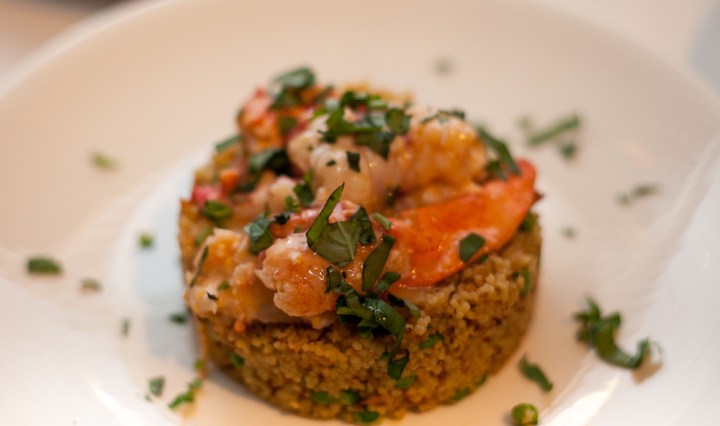
On the 1st anniversary of StefanGourmet.com I wrote “ I would love for all of my blogging friends to meet and go on a big cooking spree together, but alas that’s not going to happen with the distances involved.” Conor from ConorBofin.com then responded “Your cook-up idea appeals.” And now, less than three months later, he is here with ‘the wife’ visiting for a weekend of cooking, eating, and a great time. I welcomed them with a dinner that included ravioli with a filling inspired by ChgoJohn’s recipe and PutneyFarm’s brownies for dessert. To include more of our blogging friends in this, we are making Richard McGary’s Butter-Poached Lobster Tails tonight. I couldn’t have … Continue reading Food Blogging Without Boundaries

My Grandmother’s Chicken Sous-Vide

Almost a year ago I wrote about my quest to recreate the braised chicken like my grandmother used to make. Most people have nostalgic memories of a favorite food made by their mother or grandmother. Just the smell of it will instantly propel you back to your childhood. In many cases the memory has been romanticized by our brains and it may therefore seem impossible to recreate it. For me, this was the braised chicken my grandmother made. Her husband, my grandfather, was the only one who had left the family farm, where his brothers and sister kept livestock including … Continue reading My Grandmother’s Chicken Sous-Vide

Roasted Potato Experiment #1: Salting Before or After?

We eat pasta and rice much more often than potatoes, but when we do eat potatoes we most often eat them roasted. This preparation brings out the taste of the potatoes themselves and gives them a nice crispy crust without using a lot of oil. There are many variables you can change when making roasted potatoes: oven temperature, salting before or after, waxy or floury potatoes, etc. I decided to do a series of experiments to find the optimal recipe. This first installment is about salt: is it better to salt the potatoes before or after roasting? Instinctively I have … Continue reading Roasted Potato Experiment #1: Salting Before or After?

Lasagne alla Napoletana (Lasagne di Carnevale)

I made this lasagna for a dear friend whom we were visiting and who couldn’t cook herself because she was recovering from a slipped disc operation. Lasagna is a great dish for such an occasion, because it can be prepared in advance and can simply be heated up in the oven. This will even improve the flavor. My original plan was to make Lasagne alla Bolognese, but when ChgoJohn wrote that he used cream cheese instead of ricotta in his Lasagne dei Bartolini I was intrigued because I had never used either of those in lasagna before. I then learned … Continue reading Lasagne alla Napoletana (Lasagne di Carnevale)

Certosino Revisited

Certosino is a traditional fruitcake from Bologna that I made around Christmas time. It is not hard to make and has a very nice flavor. It tasted great but I wasn’t completely happy with how it looked: I used a rectangular pan because I didn’t have a round pan of the proper size, and I wasn’t sure that the baking soda had done its job properly. I decided to make it again, using baking powder rather than baking soda (even though Italian recipes all call for bicarbonato, which is baking soda) and using a newly bought 20 cm (8″) round springform … Continue reading Certosino Revisited

Homemade Ebi Nigiri Sushi (Shrimp Sushi)

One of my favorite types of sushi is ebi nigiri. The shrimp has a very nice slightly sweet flavor that goes very well with the rice and it also looks pretty. Although most people think of raw fish when they think of sushi, the shrimp is actually parcooked for this preparation. I’ve already explained how to make sushi rice and shape nigiri sushi in a previous post. In this post I will only deal with how to prepare the shrimp. For this preparation it is important to buy raw shrimp with the shells on. It is not important to have … Continue reading Homemade Ebi Nigiri Sushi (Shrimp Sushi)

Pork & Beef Ragù Napoletano

It is Carnival and that is the festive season before Lent, a period of six weeks in which it was not allowed to eat meat. And that meant of course that during Carnival one would eat as much meat as possible. The word carnival comes from Latin “carnem levare”, which means “eliminate meat”. In the south of Italy and especially around Naples, the end of Carnival on Mardi Gras/Fat Tuesday or martedì grasso in Italian, is celebrated by eating Lasagne di Carnevale or Lasagne alla Napoletana. This lasagna is different from the better-known Lasagne alla Bolognese, which is made from Ragù … Continue reading Pork & Beef Ragù Napoletano

Dining in Amsterdam: &Samhoud Places**

Chef Moshik used to be the chef of restaurant ‘t Brouwerskolkje in Overveen, half an hour west of Amsterdam. He has recently moved to Amsterdam under a new name: &Samhoud Places and immediately received two stars from Michelin (the same as at Brouwerskolkje). We were curious and so went to pay a visit. We had the 7-course “Inspiration” degustation menu (EUR 159.50) with wine menu (EUR 65) and black truffle supplement (EUR 20). Photos made with my iPhone. The amuse bouche are travel themed: Hong Kong, Venice, Chicago, and Moscow. The first is dim sum of scampi: both the filling and … Continue reading Dining in Amsterdam: &Samhoud Places**

Chicken Quesadillas

Quesadillas make me think of summer, and even though it is in the middle of winter with snow and everything, I decided to make chicken quesadillas just to bring a bit of summer to our table. I based this on a post by Cher aka The Pasta Princess. Thanks for inspiring me to make this! Quesadillas are quite easy to make and great if you like cheese. Yes, the “quesa” in the name refers to the Spanish for cheese (queso). We both love cheese, so it is strange that I had not made these before. I definitely will be making … Continue reading Chicken Quesadillas

How to make Fresh Pasta Dough using a Stand Mixer

I’m really happy with my new stand mixer. One of the things it does really well is making pasta dough. Of course you can also do this by hand, but especially when you’d like to make pasta dough from eggs and 100% semola di grano duro rimanicato (rather than 50% or 100% flour of type “00”) it is much more pleasant to use the stand mixer instead. Such dough can be very tough and difficult to knead, but the stand mixer does the trick as easily as with 00 flour. A stand mixer is also great if you’re lazy! Sometimes … Continue reading How to make Fresh Pasta Dough using a Stand Mixer

Italian Green Sauce (Salsa Verde)

Salsa Verde is a green sauce that is great with boiled meats, like the chicken that’s left over when you make brodo (broth) for tortellini. It is also good with steamed or baked fish. Salsa verde turns bland fish or chicken into something really nice. With a blender it is very easy to make. The main ingredients are parsley, capers, garlic, anchovies, vinegar, and olive oil. There are many recipes for salsa verde around, some also include pickles, fresh breadcrumbs, or hard-boiled egg yolks. I like to include a bell pepper. In the photo you can see that the Salsa Verde I … Continue reading Italian Green Sauce (Salsa Verde)

Chocolate-packed Brownies

Many recipes on the internet claim to be “the best”. After trying PutneyFarm’s recipe for the “Best Brownies Ever”, I have to say that in this case I agree. The recipe is the result of Carolyn’s experiments to pack as much chocolate into brownies as possible, and although I haven’t challenged the recipe by trying to pack more chocolate into them, these brownies certainly taste that way. They are no more difficult to make than other brownie recipes, but they are a hell of a lot more delicious! I also like that these brownies fool you a little. Did you … Continue reading Chocolate-packed Brownies

What to do with leftover Peking Duck: Pappardelle all’Anatra

When you make Peking Duck, you only eat the crispy skin and just a bit of the meat right underneath. This means that you will have a lot of leftovers: the carcass as well as most of the meat. It is a shame to throw all of this away, especially since you can use this to make a classic Tuscan pasta dish: Pappardelle all’Anatra. The carcass is used to make a stock, and both meat and stock are used in the pasta sauce. The cooking time is quite long, but there is hardly any active time. Here’s how to do it. Ingredients … Continue reading What to do with leftover Peking Duck: Pappardelle all’Anatra

Homemade Pancakes for Peking Duck

I haven’t been able to write a new post for almost a week because I was in bed with a pretty bad case of the flu 😦 This has been my longest time without a post since I started blogging. Making your own Peking Duck turned out to be quite simple, and so is making your own pancakes to eat it with! I found this recipe on Christine’s Recipes. Making these pancakes from scratch is easy. A good tip in the recipe is to roll out two pancakes on top of each other, as this makes it easier to make them very thin. … Continue reading Homemade Pancakes for Peking Duck

Simple Peking Duck

I love Peking Duck, but I always thought it was very difficult to make at home. I could hardly believe it when I saw the very simple recipe described by Stéphane on his blog My French Heaven. He just boils the whole duck with some honey and soy sauce, allows it to dry in the refrigerator and then roasts it for 1.5 hours at 250C/480F. I tried this and the result was quite good! Thanks Stéphane! Peking Duck is one of my favorite Chinese dishes. You eat pieces of crispy skin with some cucumber and scallions with a sauce, rolled … Continue reading Simple Peking Duck