In many touristy areas of Thailand, it is surprisingly difficult to find authentic local dishes because the food scene has adapted to the tastes and expectations of international visitors. Restaurants, night markets, and even street food stalls tend to serve a standardized set of ‘safe’ Thai classics that tourists recognize, often adjusted to be sweeter and less spicy than the originals. Local communities in beach destinations no longer form the primary customer base, causing regional specialties and traditional recipes to disappear from menus in favor of dishes that sell quickly and appeal broadly. As a result, the vibrant diversity of Thai cuisine—so visible in Bangkok or non-touristy inland towns—is flattened into a predictable, tourist-friendly version that barely resembles what Thai people actually eat.
This contrasts sharply with Italy, where regional culinary identity remains deeply rooted and fiercely protected. Even in highly frequented areas, a substantial portion of restaurants typically focuses on local dishes, seasonal ingredients, and long-established traditions that locals expect to see upheld. Italian diners are highly invested in the authenticity of their regional cuisine and will not hesitate to reject dishes that stray from accepted norms, which pressures restaurants to maintain strict standards. Because locals—not tourists—continue to drive the food culture, Italian regional diversity remains intact and vibrant, creating a completely different culinary landscape from the tourist-shaped menus often found in Thailand.
In Italy, there is a strong correlation between a restaurant’s quality and its adherence to local traditions. To find a good meal, one often only needs to look for a menu dominated by regional specialties. Seeing spaghetti alla carbonara outside of Lazio, or prepared with cream, or the ubiquitous spaghetti alla bolognese (which should be tagliatelle) is a clear signal to stay away. After weeding out tourist traps in this manner, there are usually plenty of excellent restaurants serving local dishes within walking distance. There are very few areas in Italy—Lake Garda being a rare exception—where you actually need a car to reach an authentic kitchen. Using this method, I have even found wonderful restaurants just a few minutes’ walk from the Colosseum in Rome.
Unfortunately, this strategy does not work in Thailand. If you are in a place like Koh Samui or Phuket and eliminate every restaurant serving dishes from outside of Southern Thailand (already a much larger area than a typical Italian culinary region), there is often nothing left within walking distance. Because the food at restaurants with these standardized menus is usually reasonably priced and of acceptable quality, I mostly resorted to them during our trip.
However, by putting in additional effort, I did discover a few hidden gems such as Locus Native Food Lab, The Gallery Restaurant (which serves authentic dishes from across the country), Bucha Gallery and Restaurant, and Ban Suan Lung Khai. All of these required a taxi or rental car to reach, as well as advance reservations. Beyond the logistical effort, another drawback is that these establishments are significantly more expensive than the standard prices for Thai food.
This is also the case at Pak Tai, one of the few restaurants on Koh Samui specializing in authentic Southern Thai cuisine. Located within the Ritz-Carlton resort, the restaurant’s premium pricing is expected given the resort’s luxury room rates.
When I first identified Pak Tai as a candidate for an authentic dining experience, I checked their website and noticed a “Journey of Flavors”—a six-course chef’s menu priced at THB 3,750++ per couple. (The “++” notation is common in Thailand’s high-end restaurants to indicate that a 10% service charge and 7% tax will be added to the bill, whereas cheaper local spots quote all-inclusive prices.) This converted to roughly 120 euros per couple; while expensive by Thai standards—where a meal often costs us only 10 euros—it seemed reasonable enough to book a table.
You can imagine my surprise when we arrived and found the exact same six-course experience listed on the menu for THB 5,500++ per couple (177 euros), representing a 47% price increase. We pointed this out to our waitress, even showing the THB 3,750 price still active on the website on my phone. To make a long story short, the staff refused to acknowledge the discrepancy or that our expectations were justified. They didn’t even make a small gesture, such as offering a glass of wine, so we ultimately chose to leave before ordering.
Afterward, I emailed the restaurant to explain the situation, noting that we expected a higher standard of service from a brand like the Ritz-Carlton. Following a second email, the Executive Chef of the Ritz-Carlton Koh Samui reached out with a gesture to compensate for the inconvenience if we were willing to give them a second chance. Consequently, we returned to Pak Tai four days later. Interestingly, despite the Executive Chef stating that the website had been updated, the old price of THB 3,750 remains visible at the time of writing on the restaurant’s website.
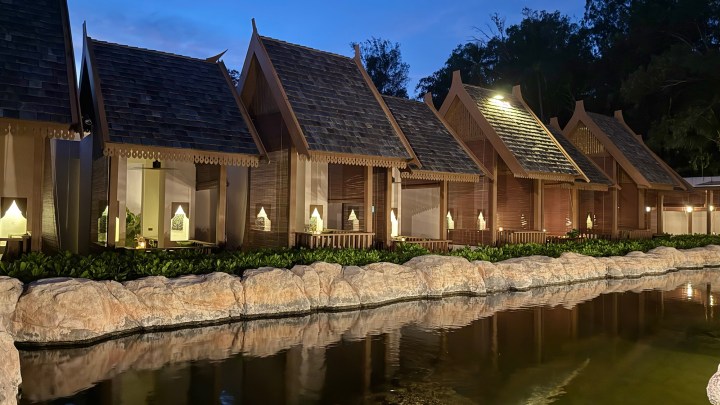
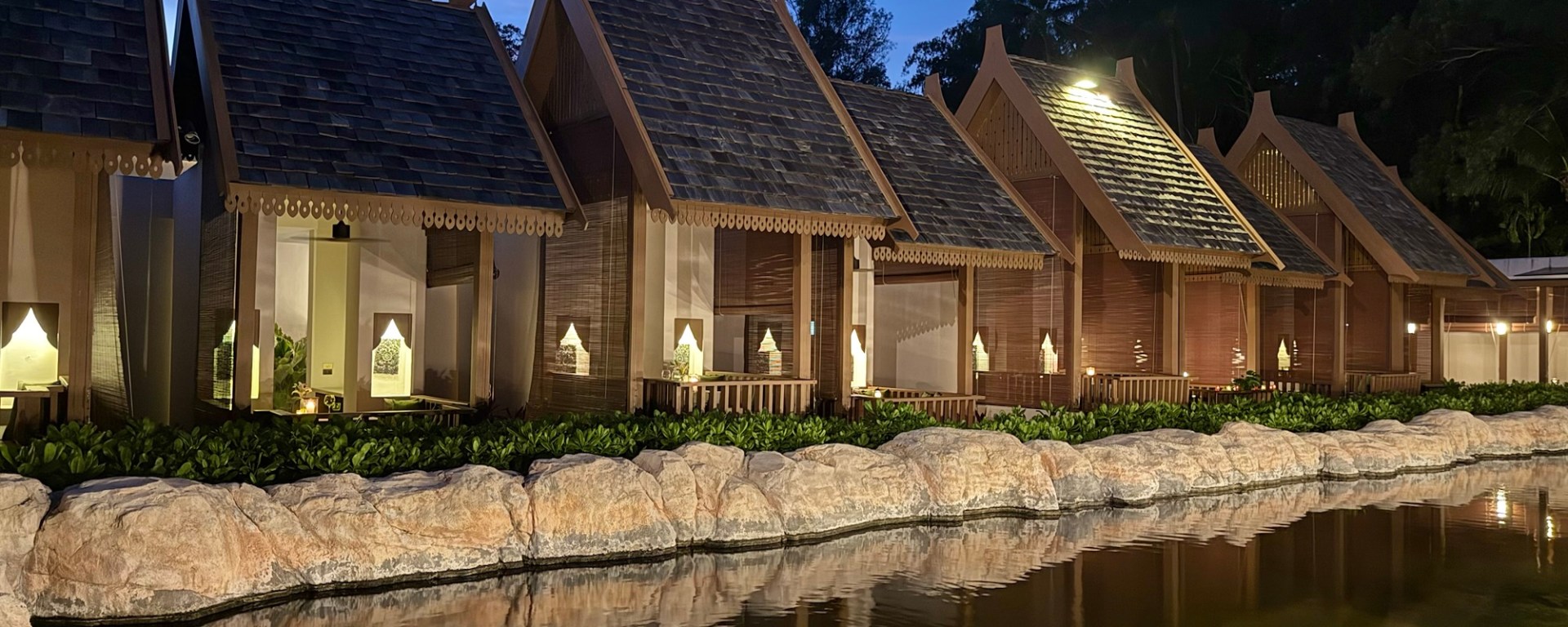
The Ritz-Carlton resort is expansive. After parking our rental car at the front gate, we were transported about 800 meters to the restaurant by golf cart. The setting is incredibly romantic, featuring individual cabins for each table that overlook a serene pond, connected by a covered walkway.
Naturally, we ordered the “Journey of Flavors” experience. It was immediately apparent that the executive chef had instructed the staff to take excellent care of us, though I also had the impression that some of the key staff members present this time had not been around during our previous visit.
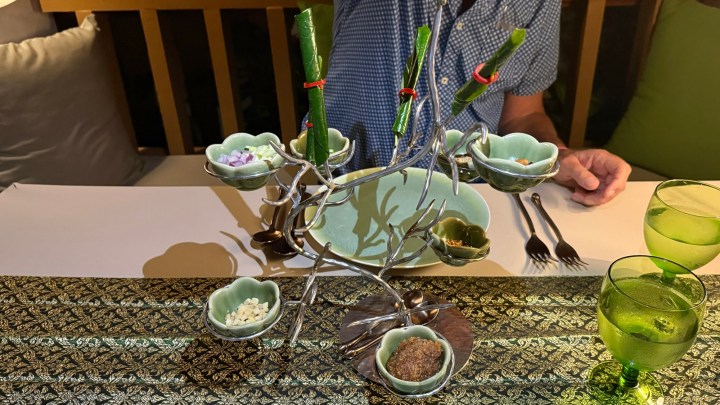
We started with miang kham, which originates from Northern Thailand and therefore seemed slightly out of place on a menu dedicated to the South. Furthermore, the ingredients did not reach the same level of quality as those at The Gallery Restaurant. Since this was not listed as part of the “Journey of Flavors,” I am unsure whether it was a standard offering or a special extra provided specifically for us.
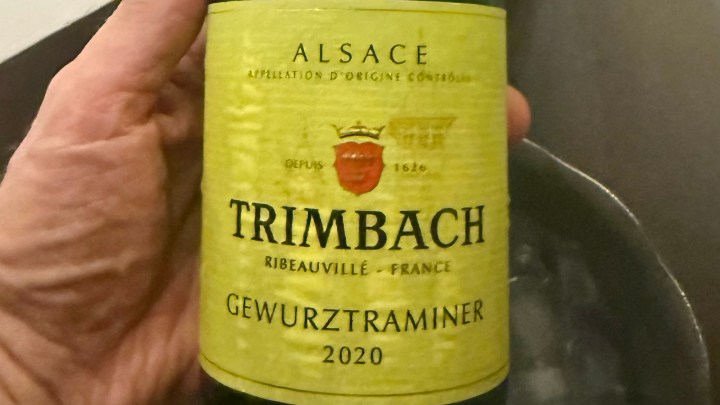
Since this was our final dinner on Koh Samui, we decided to celebrate and splurge on a bottle of wine. Pak Tai offers an extensive wine list for Thailand, with prices approximately double what you would pay in a restaurant in the Netherlands. I selected a Gewurztraminer from Alsace, produced by one of the region’s most renowned estates—a reliable choice to pair with Thai cuisine, particularly seafood. The wine was medium-dry, offering a noticeable sweetness without crossing into dessert wine territory, and it complemented the dishes beautifully. We asked the waitress for small pours, as the wine warmed up very quickly in the glass given the hot, humid climate.
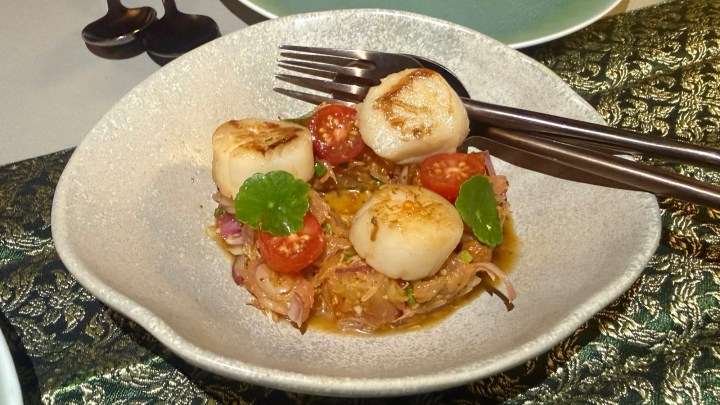
The menu consisted of six dishes served across four courses: two appetizers, one soup, two main courses, and a dessert. The first appetizer was yum som-o hoi shell, a Thai pomelo salad with pan-seared scallops, shallots, cashew nuts, mint, cherry tomatoes, and chili paste.
The pomelo salad offered a very nice balance of flavors. However, the scallops felt somewhat disconnected from the dish and had not been seared optimally; the heat was clearly not high enough, resulting in a lack of browning while still being slightly overcooked.
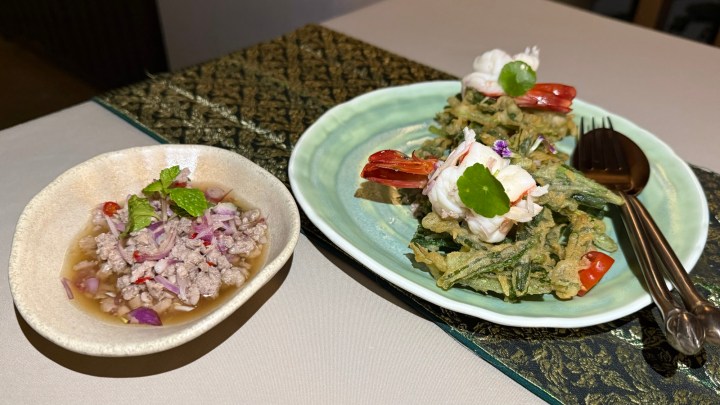
The second appetizer was excellent and consisted of two components intended to be enjoyed together: morning glory tempura with black tiger prawns and a salad of minced chicken with shallots, chili, and lime dressing. The latter resembled a Southern version of laab, though with fewer herbs and without toasted rice powder. It was quite spicy; although we had mentioned we were comfortable with heat, this turned out to be the only truly spicy element of the meal. The morning glory tempura was superb—light and crispy, a technical feat given the ‘limp’ nature of the vegetable and the difficulty of maintaining such a texture in a humid climate. The combination of the two worked perfectly. The Thai name for this dish was yum pak boong grob.
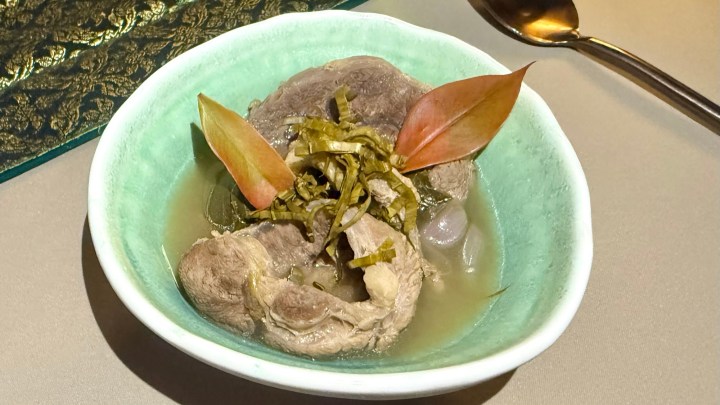
The soup was Nueh Tom Bai Chamuang, a beef shank stew in a sour aromatic broth made with chamuang leaves. These leaves are a staple of the local cuisine and were also on the menu at “The Gallery”. The beef shank had been slow-cooked for four hours and was tender. As is customary in Thailand, only a fork and spoon were provided. Since the beef shank was served in whole slices, it was somewhat messy to eat without a knife; however, the flavor was excellent, and the meat and broth complemented each other perfectly.
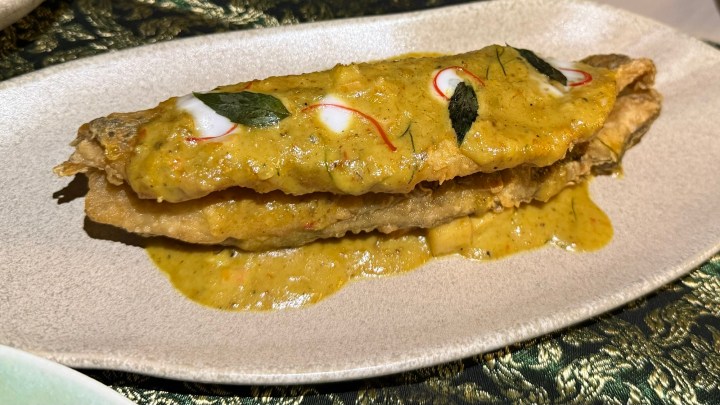
The first dish of the main course was Pla Kra Pong Tord Rad Prik Gang, a deep-fried sea bass fillet with heart of coconut and a red curry. The sauce actually appeared yellow due to the generous amount of coconut milk and cream. The curry had been reduced until it was thick with a nice, deep flavor, though it was not particularly spicy. The fish was perfectly cooked—tender and juicy. As is standard, the main courses were accompanied by a side of steamed Jasmine rice.
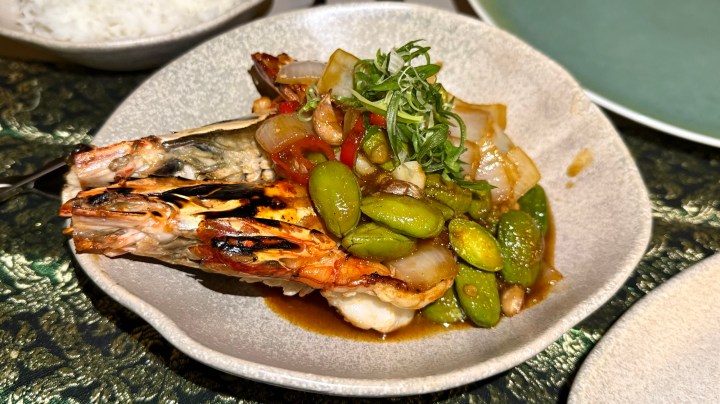
The second part of the main course was Goong Phad Priew Wann Sator, grilled king prawns with a sweet and sour sauce and ‘stinky’ beans. The restaurant manager, who is from the area, mentioned that these beans are a local favorite. They were slightly bitter and, as the name suggests, a bit ‘stinky’. The sweet and sour sauce was excellent and well-balanced, making it far more refined than most typical sweet and sour sauces.
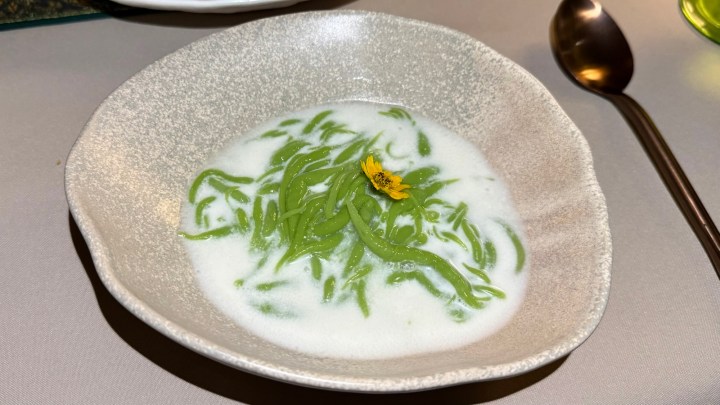
The dessert was Lod Chong Nam Kati, pandan jelly noodles in coconut milk. The menu also mentioned coconut ice cream, but if it was included, it was already melted. Compared to the Kanom Co at Ban Suan Lung Khai, this was less interesting, as it lacked the element of caramelized, crunchy palm sugar.
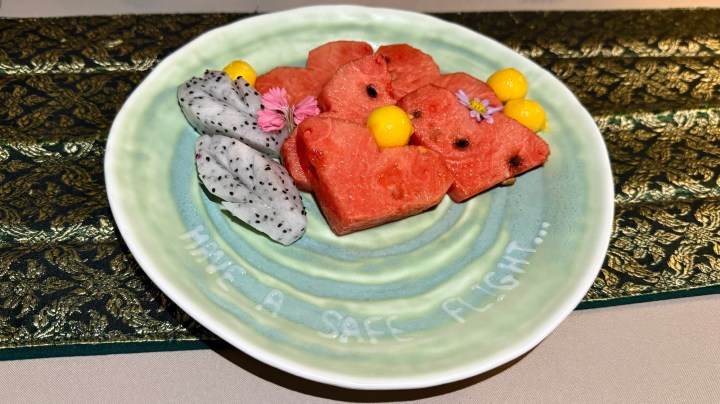
There was also some fruit, accompanied by a message wishing us a safe flight since we had mentioned we would be returning to Bangkok the next day.
The service during our second visit was excellent, and the staff spoke more English than at other restaurants (excluding, of course, the native English speakers at some of the venues I have reviewed over the last few weeks). It is nice to be able to chat with the serving staff; this is an important element, especially if, like us, you are interested in learning about the food culture.
The food was very good, featuring several enjoyable dishes that we had not tried before. I do not have enough knowledge of Southern Thai cuisine to speak definitively about its authenticity, but the meal was surely less spicy than what locals would eat. While we had requested it to be less spicy than the Thai standard, we also asked for it to still have a ‘kick’, and it seemed they preferred to err on the side of caution.
At the new price of THB 5,500++ per couple, the cost is roughly the same as Locus and The Gallery, yet the food is not as refined. At Pak Tai, you seem to be paying for the location, both the romantic setting and the prestige of being inside a Ritz-Carlton resort. I do not think they host many guests from outside the resort. In that aspect, we are atypical travelers: we are willing to spend significantly for excellent food, but not for luxury lodging (it is fine as long as it has a good bed, a good shower, effective A/C, and is quiet). As a final note on pricing, a 0.7 or 0.75-liter bottle of water was THB 500++ (16 euros), which is completely ridiculous. This high price is partly due to it being imported bottled water, which is ridiculous in itself.


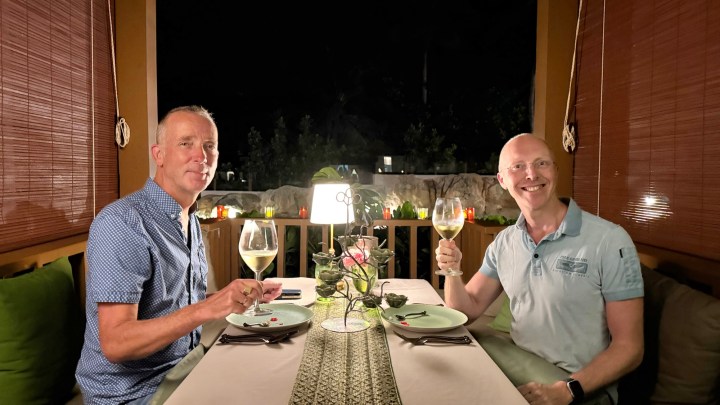
Am laughing as I keyboard having just finished and early dinner and nibbling from a fruit plate almost a copy of yours, including the dragonfruit 🙂 ! Since I wanted to be an architect/designer methinks you will understand the dining cabins getting the first loud clap. Another goes to the photo of the two of you . . . one of the best I have seen. The food . . . I am certain it tasted fine but somehow did not look very Thai to me . . . do like the look of the pandan jelly dessert which is not usual for yours truly! Would not have minded the morning glory tempura or the grilled prawns . . . thanks for taking the trouble to write . . . and have a good flight . . .
LikeLiked by 1 person
So fascinating! You’re very shrewd my friend. Good on you! The meal looks fantastic.
LikeLiked by 1 person
Another memorable meal!
LikeLiked by 1 person