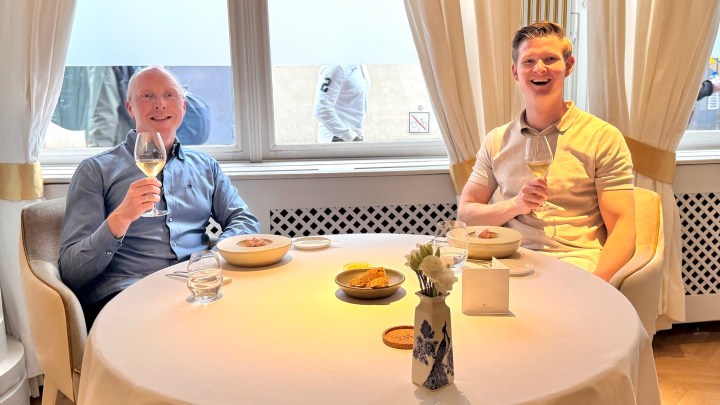
Last Friday I took my friend Martijn out to dinner for his birthday. For me, the ultimate fine dining experience is a parade of exquisite dishes and wines that lasts a full evening. Where each dish delights, every wine is sublime, and the dish and wine elevate each other. Finding such an experience can be quite elusive, as many restaurants do not even offer a tasting menu with wine pairing, and those that do often offer a wine pairing that is not at the level of the food, or wine pairings that are more aimed at generating revenue than the result of a quest to find the perfect pairing by tasting.
Before I stepped foot in The White Room for the first time last night, and even when I made the reservation, I had no idea that this restaurant offers precisely that experience.
The full name of the restaurant is “The White Room by Jacob Jan Boerma”. Jacob Jan Boerma was the owner and chef of De Leest in Vaassen from 2003 to 2019, where he held three Michelin stars from 2014. I had the pleasure of dining there three times, and my visits in 2014 and 2016 are documented on the blog. He opened The White Room in 2016 in the five-star Hotel Krasnapolsky on Dam Square in the heart of Amsterdam. While Boerma is the signature chef, he does not actually cook there. The White Room has seen several chefs de cuisine over the years and has held one Michelin star since 2018. The current chef de cuisine is Tristan de Boer, who has been at the helm since 2021.
Although I have a reputation for frequenting Michelin-starred restaurants, I have not actually tried all of them in Amsterdam. I do most of my fine dining while traveling, as I would often prefer to spend money on high-quality ingredients and wine at home. I love cooking, and it frequently results in a better experience for me than many one-star restaurants, while saving money at the same time.
I was certainly aware of The White Room, but because Jacob Jan Boerma was not the one cooking and the restaurant seemed expensive and aimed primarily at hotel guests, it never appeared on my radar. If I had known they offered a premium wine pairing (information not listed on their website) and that the chef had spent two years as sous-chef to Sidney Schutte at Librije’s Zusje, I might have tried it sooner.
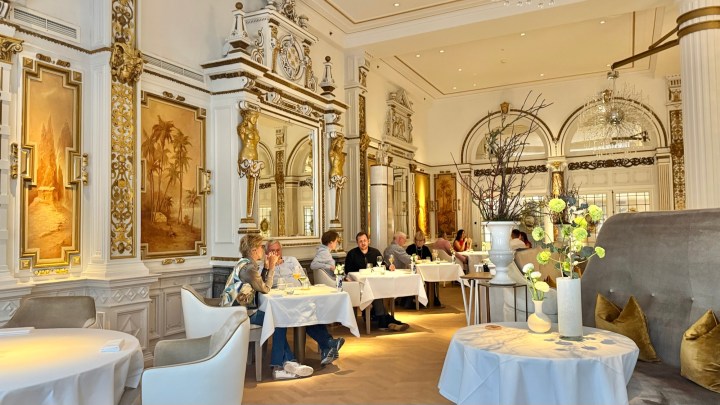
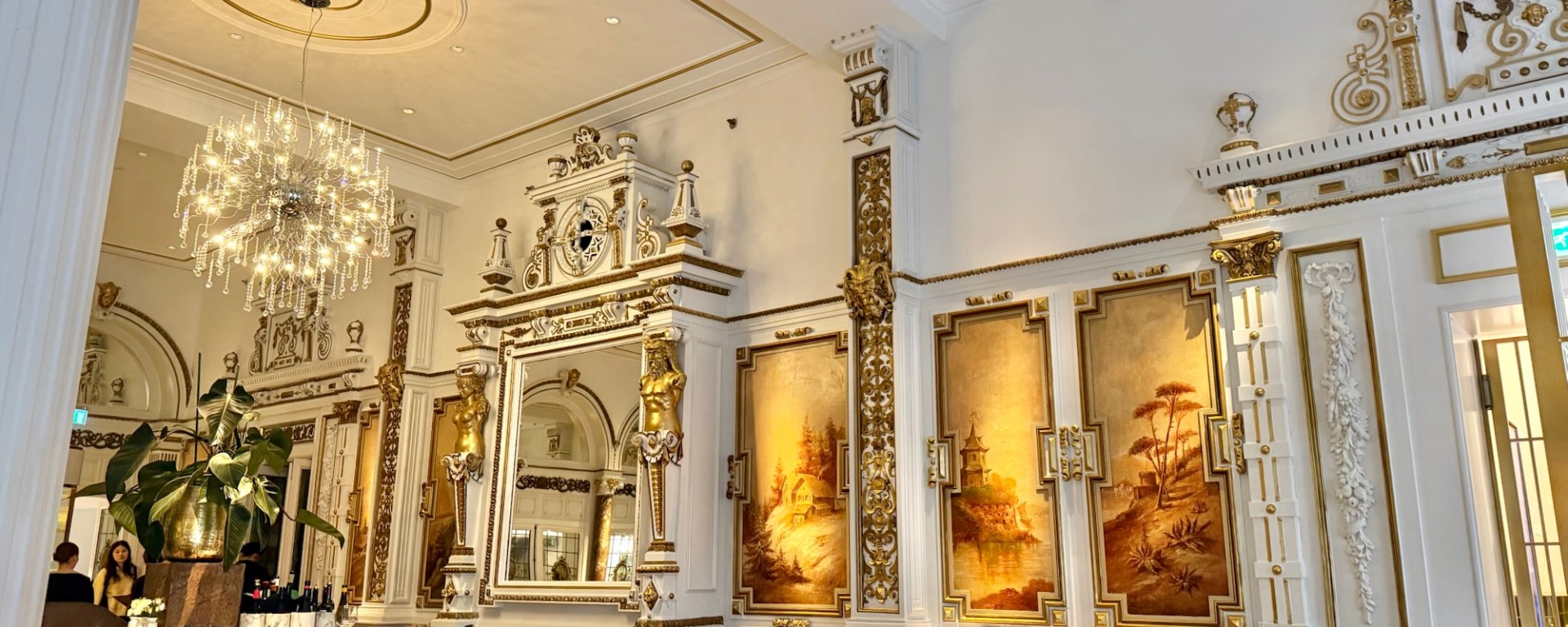
The restaurant is located in a historic dining room opened in 1885 by Krasnapolsky in what later became the Krasnapolsky hotel. Its original name was “De Witte Zaal”, which translates to “The White Room”. As a national monument, the space features beautiful belle époque details and was carefully restored before the current restaurant opened.
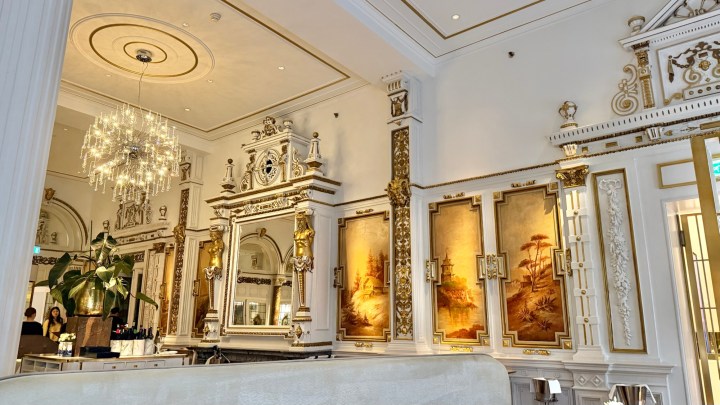
The White Room does not offer à la carte dining, providing only two seven-course tasting menus: Gold, featuring meat and seafood, and Green, which is vegetarian. Both are priced at 185 euros. An optional cheese course—served as a composed dish rather than from a cart—can be added for a supplement of 39 euros, with the option to share. While a regular wine pairing is available, we opted for the premium pairing, priced at 200 euros for seven glasses.
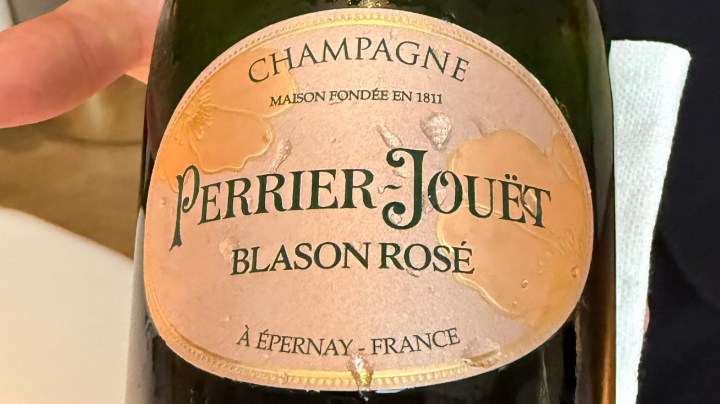
There were seven different sparkling wines available by the glass. I appreciated that the champagne cart had a price list, as often you are asked to choose an aperitif without knowing the prices and then only discover when the check comes you ordered something that was 50 euros per glass. The White Room has six different Champagnes from Perrier-Jouët, and we opted for the Blason Rosé, a blend of 50% Pinot Noir (partly vinified as a red wine to create the rosé), 25% Chardonnay, and 25% Pinot Meunier.
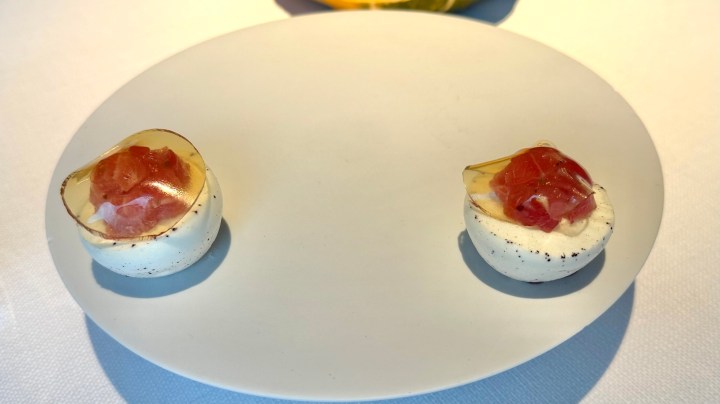
The first amuse bouche was a meringue topped with fatty tuna sashimi, blueberry and shiso.
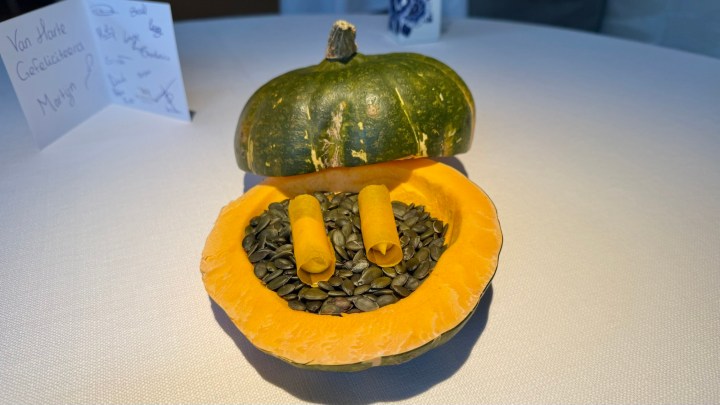
The second was a brittle cylinder with pumpkin and cardemom that was so delicate that it was difficult to pick up without breaking.
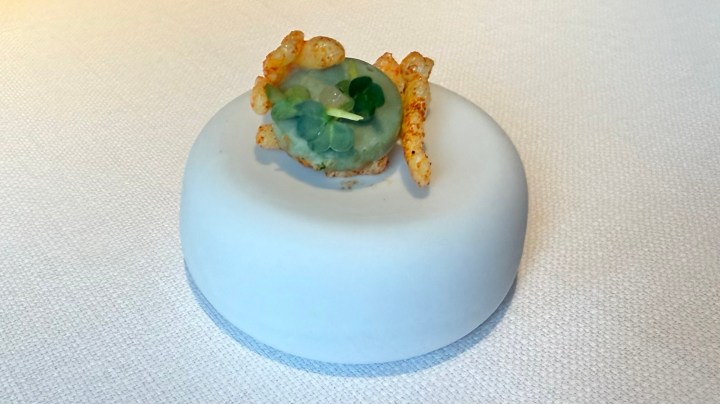
The third was cavolo nero with cumin, which could have been called cumin with cavolo nero as that was the dominant flavor. This amuse was a good indication of what was to follow, because it had a deep and complex spice flavor that was perfectly balanced.
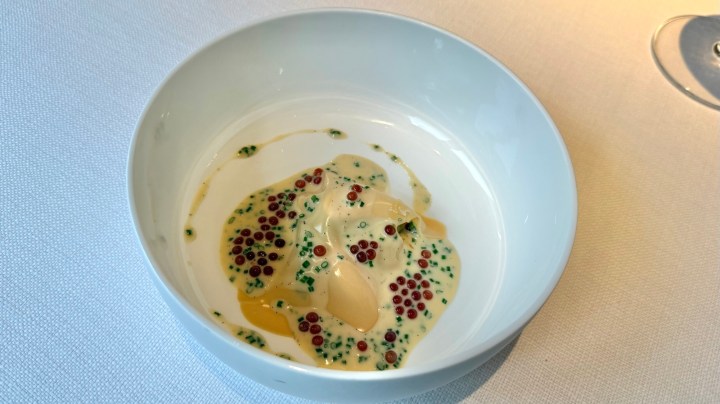
The fourth was a barbecued oyster with a vanilla beurre blanc and trout roe. Again the spice (vanilla) was main feature but without overpowering the oyster.
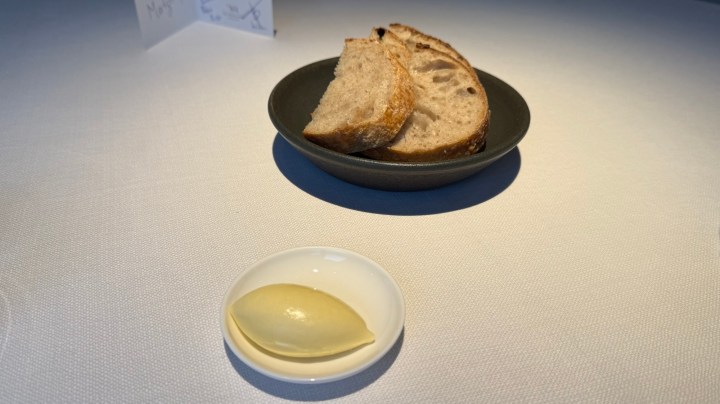
The excellent sourdough bread was also served as part of the amuse-bouche. Some restaurants now present bread as a course by itself, and while I believe bread is important and deserves recognition, presenting it as an amuse-bouche feels more appropriate.
The bread was served with what was described as “beurre noisette.” Typically, this is butter heated until it attains the distinct color and aroma of hazelnuts. In this case, the profile seemed very close to regular butter, which left me curious. When I asked about it, a sous-chef kindly came to the table to explain their process: they prepare a beurre noisette in the kitchen, filter out the browned milk solids using a cheesecloth, and then mix the remaining fat with regular butter before whipping it.
I suspect this thorough filtering removes much of the characteristic beurre noisette profile. The effect was so subtle that I found it difficult to discern the difference in aroma, taste, or appearance, though perhaps a side-by-side comparison would have made it more apparent. The butter itself was high quality and perfectly enjoyable, but it was interesting to learn they go to such lengths for a result that remains so understated.
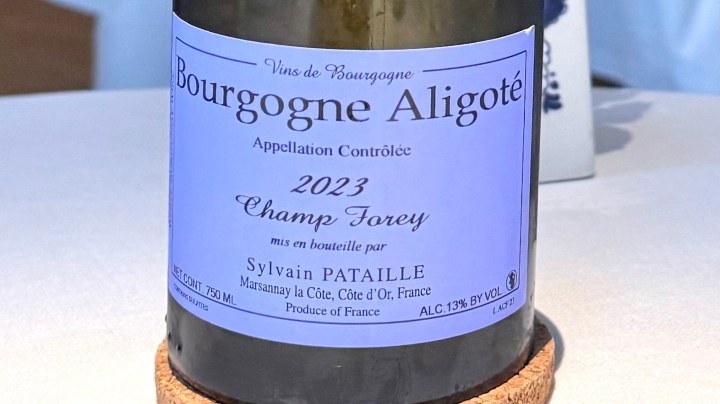
The first wine of the pairing was the Bourgogne Aligoté Champ Forey 2023 by Domaine Pataille. Aligoté is the “other” white grape variety from Burgundy that is gaining popularity because it retains its acidity despite climate change. That high acidity requires techniques like sur lie aging to achieve a balanced wine, and that is exactly what was done here.
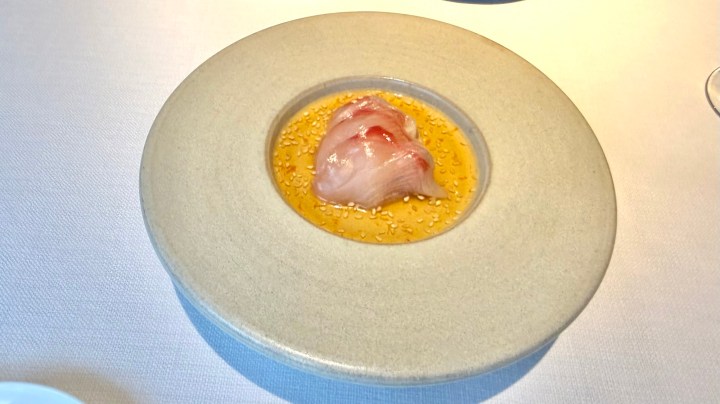
It was paired successfully with a dish of Kingfish sashimi and Kingfish ceviche with sesame and sudachi, a Japanese citrus fruit that is like a spicy and more sour version of an orange. I would never have thought to pair such a dish with Aligoté, but it worked very well and made for an excellent, fresh beginning to the menu. It was almost like a palate cleanser, though calling it that would not do the dish justice. The kingfish was impeccably fresh and tender, with the belly served as sashimi and the loin as ceviche.
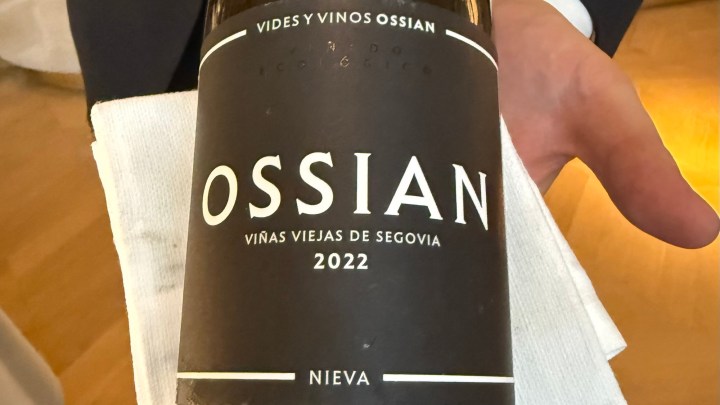
The second wine was the Ossian Viñas Viejas Verdejo 2022 from Spain, produced from pre-phylloxera vines up to 200 years old grown in sandy soils at high altitudes (around 850 meters) in the Nieva area. The wine was fermented in small oak barrels with indigenous yeasts and spontaneous fermentation, followed by nine months of lees aging. It is deliberately kept out of the Rueda DO as the style is entirely different and more Burgundian than the typical fresh, aromatic Rueda Verdejo.
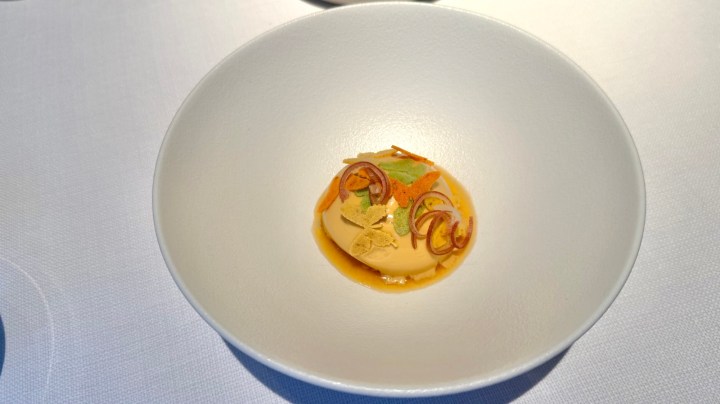
It was a great pairing for the North Sea Crab with red curry and Myoga. Myoga is Japanese ginger, so this dish combined both Japanese and Thai influences. The yellow, red, and green “leaves” on top represent the three main types of Thai curries. The dish had all the complexity of a high-quality red curry but with only a hint of chili heat, ensuring the curry did not overpower the gentle sweetness of the crab.
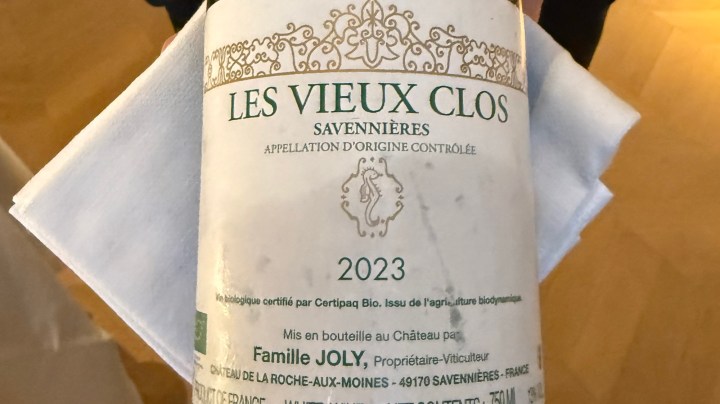
The third wine was the 2023 Savennières “Les Vieux Clos” by Domaine Joly, a Chenin Blanc from the Loire region in France. This is a complex wine featuring the typical aromas of the variety, such as bruised apple, with significant concentration and texture. It was a great pairing for the langoustine with Masala, Markoesa, and lovage.
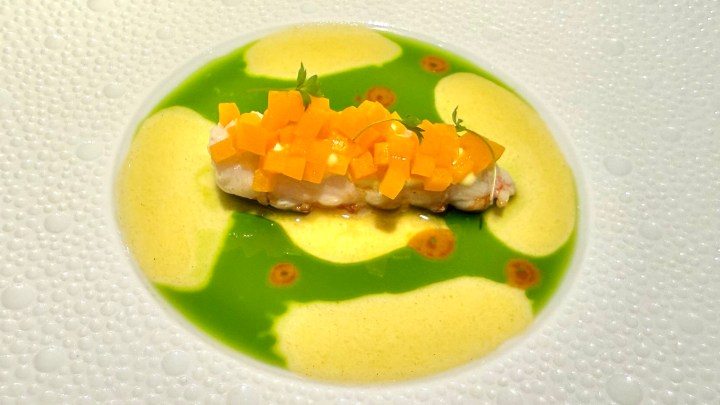
Markoesa is a yellow type of passion fruit from Suriname with an intense tropical aroma. The pairing of Markoesa and Masala makes this a Suriname-inspired dish, reflecting the Hindustani (Indo-Surinamese) influence that serves as one of the most significant pillars of Surinamese culture and cuisine.
The langoustine was perfectly prepared, seared on one side while remaining barely cooked on the other, and topped with crunchy pickled squash cubes. The Markoesa and lovage provided vibrant yellow and green accents on the plate, while small drops of a rich langoustine bisque added further depth of flavor.
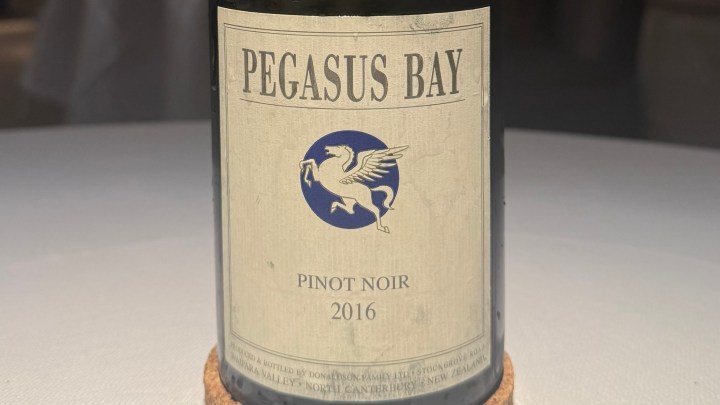
The wine pairing continued with a 2016 Pegasus Bay Pinot Noir from the Waipara Valley in North Canterbury, on the South Island of New Zealand. This wine was crafted using 30% whole bunches and aged for 18 months in French oak barriques, 40% of which were new. Beautifully matured and at its peak drinking window, it offered a complex array of primary, secondary, and tertiary aromas with velvety tannins.
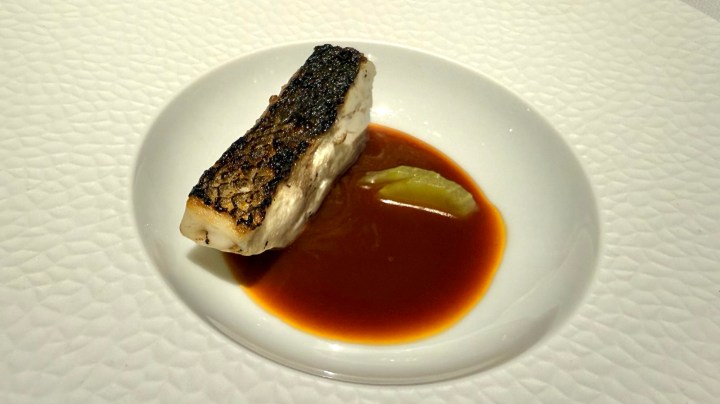
Served slightly chilled, it defied my usual skepticism regarding red wine and fish pairings—which often feel like a forced attempt to include reds in a tasting menu. However, this pairing with the Branzino “Ikan Bali” was excellent. The Branzino (European seabass) was expertly grilled and served with a jus based on the Balinese spice paste, Bumbu Bali, which provided a wonderful depth, complexity, and balance that harmonized perfectly with the aged Pinot Noir.
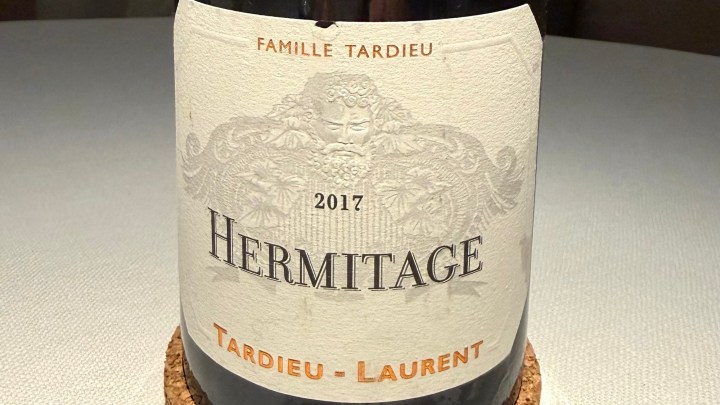
The wine for the main course was a 2017 Hermitage by Laurent Tardieu. As the most famous appellation in France’s Northern Rhône Valley for Syrah, Hermitage typically requires aging to soften its naturally firm tannins. This bottle was beautifully matured, offering velvety tannins and complex aromas while—much like the previous Pinot Noir—retaining its vibrant fruit.
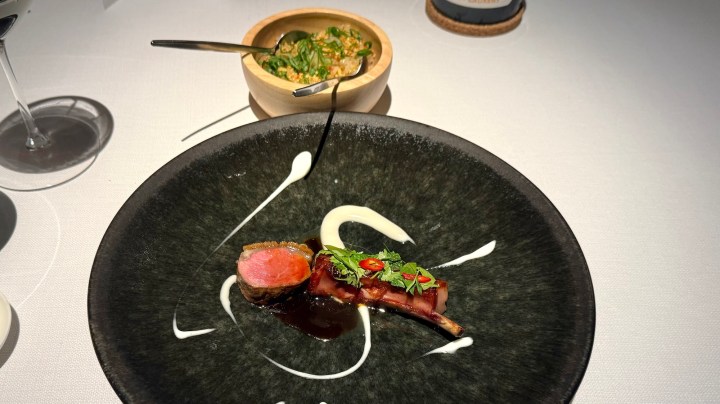
It proved to be an outstanding pairing for the lamb with green curry and fried rice. The lamb cutlet was prepared in two distinct ways: the fillet was perfectly medium-rare, juicy, and tender, featuring a nicely rendered and crispy fat cap. Meanwhile, the meaty rib had been slow-cooked to a “fall-off-the-bone” tenderness that was incredibly flavorful and topped with a fresh salad of Thai green herbs.
The accompanying fried rice was equally impressive. While every course and pairing was exceptional, this was likely our favorite of the evening. The synergy between the dish and the wine was remarkable, with both elements displaying an amazing level of complexity and balance.
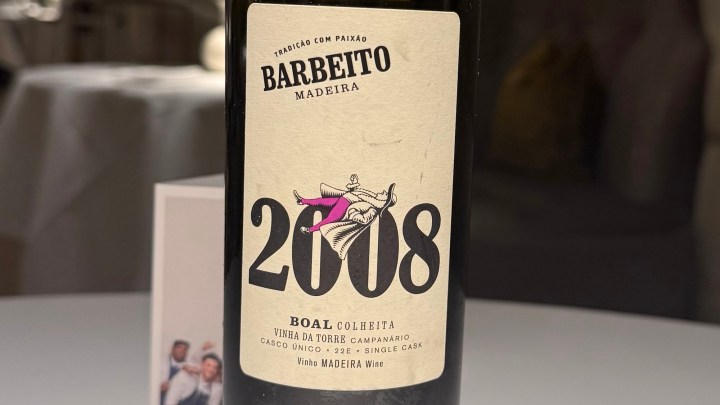
We decided to share the cheese course, and this Barbeito Vintage 2008 Madeira Boal was added to the pairing to accompany it. The wine possessed the characteristic high acidity of a fine Madeira, which was beautifully balanced by a gentle sweetness.
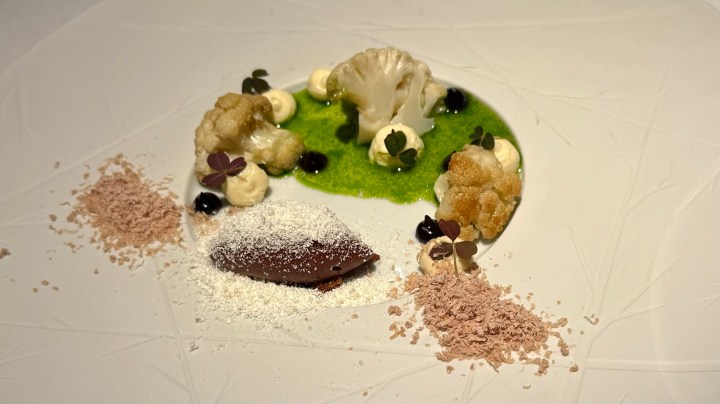
It was a perfect match for the Pierre Robert cheese served with roasted cauliflower, Kenjoer, grated frozen foie gras, and a red wine sorbet. Kenjoer is a distinct type of aromatic ginger frequently used in Surinamese and Indonesian cuisine. This was far more than just a selection of cheese with accompaniments; it was a fully realized, complex dish where the cheese served as an integral element of the composition.
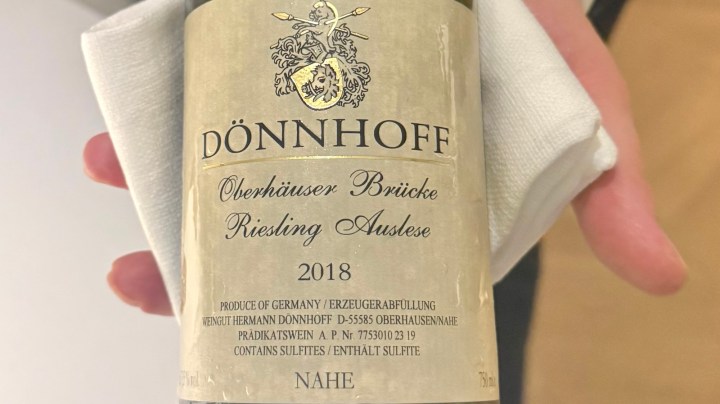
Martijn loves dessert, so he was in luck with two courses, each accompanied by its own dessert wine. The first was a 2018 Oberhäuser Brücke Riesling Auslese by Dönnhoff from the Nahe region in Germany. This was a very well-balanced Riesling featuring that classic, sought-after aroma of petrol.
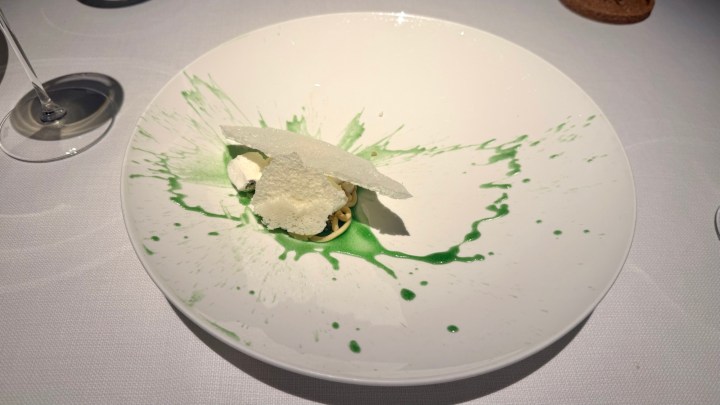
It proved to be a great pairing for the smoked mascarpone, which was served with various structures of buttermilk, tarragon, and cajeta—a luxurious goat milk version of dulce de leche. The tarragon did more than just provide its characteristic herbal flavor; it also transformed the plate into a striking piece of modern art.
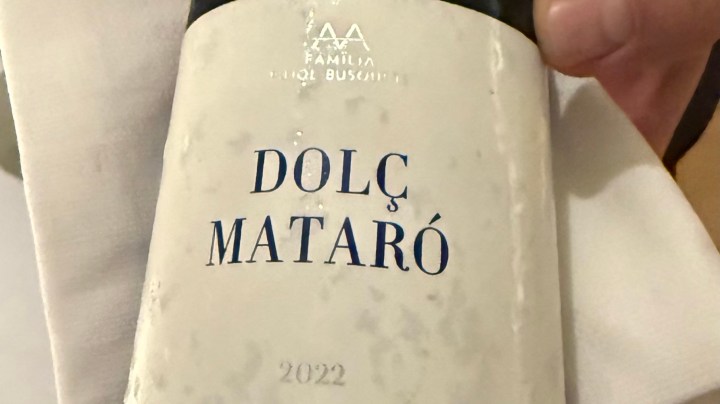
The second dessert wine was the 2022 Dolç Mataró by Alta Alella, a late-harvest Monastrell from Catalunya in Spain. Despite containing 176 grams of residual sugar per liter, the wine remained beautifully balanced by an acidity that was notably higher than the Monastrell Dulce typically found in the more southerly Jumilla region.
The wine displayed wonderfully complex aromas of dark fruits, particularly blackberries. As a wine nerd, it was interesting to see the variety locally called Mataró here; while I am well-acquainted with it as Mourvèdre in France or Monastrell elsewhere in Spain, Mataró is a name for the grape I had previously only encountered in Australia.
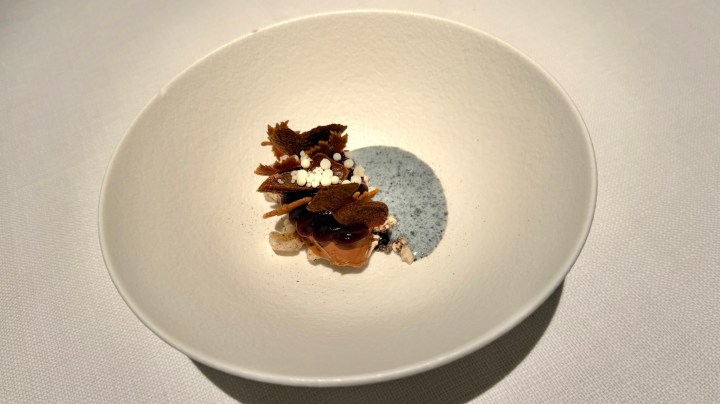
The wine was an excellent pairing for the final dessert of porcini mushrooms with chocolate, blackberry, and tonka beans. The deep earthiness of the mushrooms harmonized perfectly with the chocolate, while the blackberries provided a bright, lifting contrast to the rich flavors.
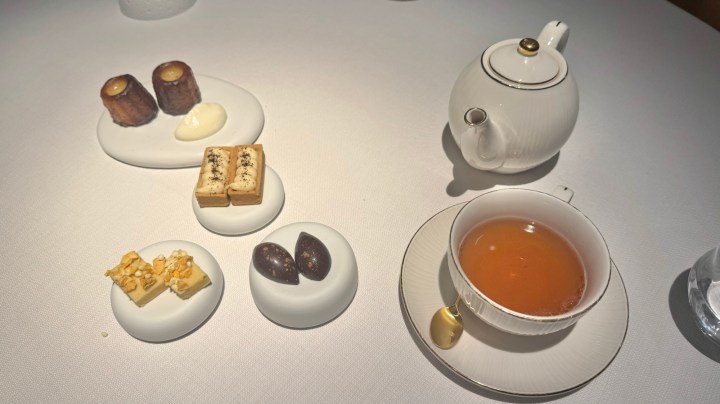
We concluded our meal with tea and wonderful friandises of impeccable quality.
It was totally unexpected to find that The White Room offered my ultimate fine dining experience—a parade of exquisite dishes and wines where each course delighted, every wine was sublime, and the pairings elevated one another. If it were up to me, the food, wine, and service were all worthy of two Michelin stars rather than one. While Michelin does not disclose its criteria, factors like the restaurant’s ownership or the branding of the ‘signature chef’ may play a role. Regardless, the level of execution here is undeniable.
Chef Tristan de Boer has a distinctive, multicultural culinary style, weaving Thai, Japanese, Indonesian, and Surinamese influences into each dish. While the influence of Sidney Schutte is recognizable—perhaps more so than that of Jacob Jan Boerma—Tristan has clearly forged his own path. His greatest strength is balance; he handles complex, punchy spice profiles with such mastery that they remain harmonious rather than overpowering. I would hesitate to call it ‘fusion.’ To me, fusion often feels like an unstable emulsion of oil and vinegar that could easily separate. In Tristan’s kitchen, these multicultural elements have been synthesized into a seamless new whole. If there is one area for further refinement, it would be the cuisson—the precision of doneness to achieve the absolute best texture. While the lamb was outstanding and all proteins were very good, I have experienced branzino and langoustine with even greater precision elsewhere. Given how young he is, he is undoubtedly a chef to watch.
The wine selection was truly excellent and well-deserving of the “premium” label. For a wine lover, it was a rare feast to enjoy bottles like a Hermitage at its peak drinking window alongside unexpected pairings that worked beautifully. The pairing also offered genuine value, avoiding the excessive markups common in many Dutch restaurants, where a single glass often costs more than the retail price of the entire bottle. It is exceptionally rare for every single pairing to achieve such perfect synergy. This is clearly the result of the rigorous tasting process—where the chef and sommeliers fine-tune the dishes and wines together—a prerequisite for excellence that few restaurants follow as strictly. It is a discipline Tristan likely honed during his time at Librije’s Zusje. The cellar is managed by two sommeliers, Frederico Figueiredo and Philip Segers. Since they each oversee half of the dining room, we were served by Philip. While I felt he needed a moment to adjust to my style at the start, as the evening progressed, we engaged in very pleasant discussions about the wines and the logic behind the pairings.
The ambiance and service were the final pieces of the puzzle. One look at the dining room confirms that the decor is spectacular, with tables spaced in a manner more reminiscent of a two-star establishment than a one-star. The service was both friendly and attentive, embodying the philosophy that the best service is the kind you don’t even notice—where the evening progresses perfectly and seamlessly. It is the small details that make this possible. For instance, a waitress cleared our plates without interrupting us because she noticed we were in the middle of a conversation. Similarly, Philip spotted from across the room that Martijn was dividing the last piece of bread and immediately brought more without being asked. The pacing of the evening was also flawless; the wines arrived exactly on time, and there was never a moment where we felt we were waiting.
The White Room is a gem hidden in plain sight. Its Michelin star and prominent location on Dam Square within a five-star hotel make it difficult to describe as “hidden,” yet the caliber of the experience remains a revelation. It offers exceptional value, providing two-star quality at one-star prices. This window of opportunity likely won’t last forever; the restaurant truly deserves a second star, and one could hardly blame them for adjusting their prices should that recognition arrive. I already find myself looking forward to my next visit.


I opened my computer to check evening mail and discovered this. As it happened, I had spent the last two hours watching the first selection night of two of the 28th year of Australian MasterChef. Please do not feel insulted that I state this first – we are going to have an inordinately wonderful year going by the talent seen and the test dishes offered. Extraordinary talent from Nigeria, Malaysia, Japan besides those born here . . . all Australians now.
Then I saw this beautifully presented dinner – don’t laugh > a perfect food night for me! Love the room – have to think back to Venice, Rome, south of France, Hong Kong, Tokyo to remember sitting in similar places. Am going back to go thru’ the food again – cannot taste thru’ the screen but the lamb ‘both ways’ thrills methinks . . . and glad you were served a New Zealand wine amongst others . . . have quite a few foodie friends across the Ditch . . . thank you!
LikeLiked by 1 person
What a beautiful dining room! I’m with Eha – my mind went to Venice! The dining experience looks top notch – such beautiful presentations. You’re such a good writer, Stefan!
LikeLiked by 2 people
Thank you, Mimi!
LikeLike
What an amazing place!
LikeLiked by 1 person
Fantastico!
LikeLiked by 1 person